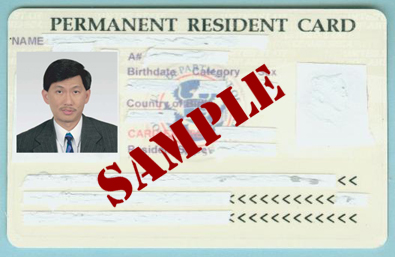
A green card makes the United States your permanent home. Formally, it gives you lawful permanent resident status, and the card itself is the Permanent Resident Card, Form I-551. For most people, it is the last major step before U.S. citizenship.
What permanent residence gives you
You can live in the United States indefinitely, and you can work for almost any employer in almost any job, without needing sponsorship or a separate work permit. You are protected by federal, state and local law, and you can travel in and out of the country, subject to the cautions below. In time, you may be able to petition for certain family members, and eventually apply to naturalize as a U.S. citizen.
What it does not give you
Permanent residence is not citizenship. You cannot vote in federal or state elections, and voting unlawfully can cost you your status and permanently bar you from naturalizing. You still travel on your home-country passport, some government and security-sensitive jobs remain closed to you, men aged 18 through 25 must register with the Selective Service, and you remain subject to the immigration laws, which means serious criminal convictions and other grounds can lead to removal proceedings. Permanent residence is durable, but it is not unconditional.
Why is it called a “green card”?
When the card was introduced in the 1940s it was printed on green paper, and the nickname stuck through decades of redesigns in blue, pink and tan. Green returned to the design in 2010, and the current card, redesigned in January 2023, is green with a red, white and blue flag. You will also hear permanent residence described as an immigrant category, in contrast to the nonimmigrant visas that authorize only a temporary stay.
Example Green Card: Front
 |
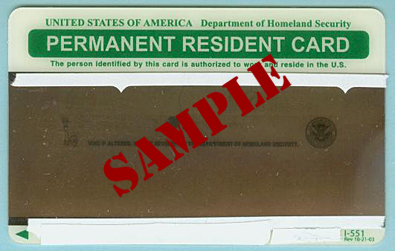
Example Green Card: Back
 |
The main ways people qualify
Most green cards come through a close family relationship or through employment. Others come through the annual diversity visa lottery, through asylum or refugee status, or through humanitarian and special categories such as trafficking and crime victims, self-petitioners under the Violence Against Women Act, and special immigrant juveniles. Each route has its own eligibility rules and its own waiting line:
How the process usually works
In most cases, someone files a petition for you — an employer or a qualifying relative — and once that petition is approved and a place in the annual quota is available, you complete the case in one of two ways. If you are abroad, you apply for an immigrant visa at a U.S. consulate and become a permanent resident when you are admitted at the border. If you are already in the United States lawfully, you may be able to apply for adjustment of status without leaving the country. An immigrant visa is therefore the travel document that leads to the status, not the status itself.
Why it often takes years
Congress limits how many green cards may be issued each year in most family and employment categories, and further limits how many can go to nationals of any single country. Where demand exceeds supply, applicants wait until their priority date becomes current in the U.S. State Department’s monthly Visa Bulletin. This is why two people with identical qualifications can wait very different lengths of time. See chargeability for how to determine which country’s quota you are counted under.
Conditional (two-year) green cards
Most cards are valid for ten years and are renewed rather than re-earned. Marriage-based residents whose marriage was less than two years old when the case was approved, and investor-based residents, instead receive a two-year conditional card and must file to remove the conditions before it expires. Missing that filing can end the status.
Keeping your status, and moving on to citizenship
Permanent residence lasts until you naturalize or lose it. Long absences can be treated as abandonment of your residence, and trips approaching or exceeding a year carry the highest risk; a re-entry permit obtained before you leave helps. You must also keep your address current with USCIS and carry your card as the law requires. After five years as a permanent resident, or three years if you are married to a U.S. citizen, you may be eligible to apply for U.S. citizenship.
Please note
This page is a general introduction, not legal advice, and immigration rules, fees and processing practices change frequently. Confirm current requirements with USCIS and the U.S. State Department, or contact us about your specific situation. Reviewed: July 31, 2026.